
How Sonoma Plaza Became the Heart of the City |
From Vallejo’s 1835 town plan to today’s markets, meetings, and community life, the Plaza has remained Sonoma’s gathering place. |
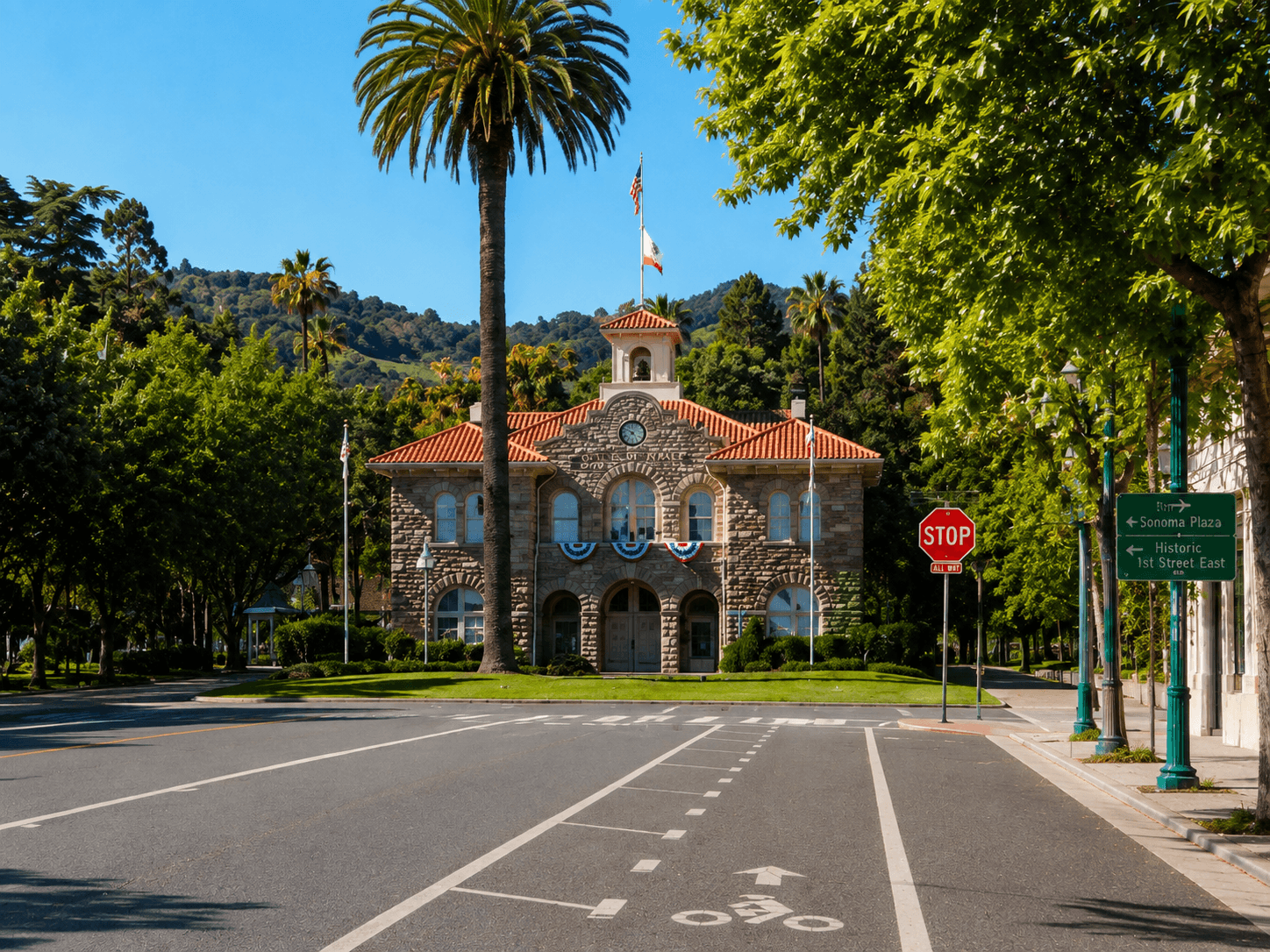
Sonoma’s central square was laid out at the heart of a Mexican frontier settlement. Nearly two centuries later, it is still where the city gathers.
On a Tuesday evening during market season, the west side of Sonoma Plaza fills with market stalls, folding chairs, and the smell of something grilling nearby.
Kids chase each other around the duck pond. A City Council meeting is wrapping up inside City Hall, dead center of the square. None of it looks planned in any formal sense. It looks like a town square doing what town squares do.
It was planned, though.
Sonoma Plaza exists because General Mariano Guadalupe Vallejo laid it out that way in 1835, on the order of Mexican Governor José Figueroa. What has changed in the nearly two centuries since is not the Plaza’s basic shape, but who it belongs to and what it is for.
A Town Designed Around a Central Plaza
On June 24, 1835, Governor Figueroa directed Vallejo, then a young lieutenant, to establish the Pueblo de Sonoma, a new settlement meant to secure Mexico’s northern frontier against Russian and American encroachment.
Vallejo laid out an eight-acre central plaza and the street grid around it. The City of Sonoma and the Plaza’s National Historic Landmark documentation both describe it as the largest plaza of its kind in California.
The Plaza was more than a park. Its broad open space served a settlement shaped by military, civic, and commercial needs, with streets and building lots arranged around it in the Spanish and Mexican colonial pattern.
That original design is still visible in the Plaza’s size and its position at the exact center of town. Everything in downtown Sonoma still measures itself from that square.
Vallejo, the Mission Era, and the Mexican Period.
Sonoma’s Plaza did not rise on empty ground.
Twelve years earlier, in 1823, Father José Altimira had established Mission San Francisco Solano de Sonoma along what would become the Plaza’s northern edge. It was the 21st and northernmost of California’s Franciscan missions, and the only one founded after Mexico, rather than Spain, governed California.
The settlement grew within a landscape long inhabited by Indigenous communities, including Coast Miwok, Lake Miwok, Pomo, Patwin, and Wappo peoples, whose lives were profoundly affected by the mission system and the colonization that followed. By the mid-1830s, Vallejo was overseeing the secularization of the mission while building a new kind of settlement around it: a civilian pueblo backed by a military presence.
He built a barracks along the Plaza’s edge to house his troops and Casa Grande, a large family home overlooking the square, for his own household.
The Sonoma Barracks still stands at the northwest corner of the Plaza today as part of Sonoma State Historic Park.
For roughly a decade, Sonoma functioned as the northern headquarters of Mexican California. From there, Vallejo, serving as military commander and director of colonization for the northern frontier, managed both defense and settlement for the region.
The Bear Flag Revolt and the Plaza’s Place in California HistoryThat arrangement ended abruptly on June 14, 1846.
A band of roughly 30 to 40 American settlers, worried about Mexican restrictions on land ownership, rode into Sonoma before dawn, took the town without a fight, and arrested Vallejo.
They raised a homemade flag, featuring a grizzly bear and a star on white cloth, over the Plaza and proclaimed an independent California Republic from Sonoma.
The California Republic did not last long.
Word soon reached California that the United States and Mexico were at war. On July 9, 1846, U.S. Navy Lieutenant Joseph Warren Revere raised the American flag over the Plaza, replacing the Bear Flag that had flown for less than a month.
The Bear Flag Monument commemorates that chapter of Sonoma history near the Plaza’s northeast corner and has been registered as a California Historical Landmark since 1932.
City Hall and the Growth of Civic Sonoma
Sonoma spent its first decades in America finding its footing. The town was incorporated as a city in 1850, briefly unincorporated in 1862 at the request of a group of landowners that reportedly included Vallejo himself, and then reincorporated for good in 1883.
The building that anchors the Plaza today, Sonoma City Hall, came later.
Its cornerstone was laid on February 22, 1906, and the building was dedicated on December 9, 1908.
Built in the Mission Revival style and placed at the exact center of the square, City Hall presents a similar face toward each side of the Plaza. Its symmetrical design reinforces the building’s role as the community’s civic center.
How the Plaza Remained Sonoma’s Gathering Place
In 1961, Sonoma Plaza was designated a National Historic Landmark.
In 1975, the surrounding Sonoma Plaza Historic District, roughly 30 buildings spanning the Mexican and early American periods, was formally entered on the National Register of Historic Places. Those designations protect the Plaza’s edges, but they do not fully explain why the middle of the Plaza has remained so busy.
That part is simpler.
A town square at the geographic and civic center of a small city keeps getting used.
City Hall gave people a reason to walk through the Plaza on business. A weekly farmers market gave them a reason to return on Tuesday evenings.
Over the decades, the city added a duck pond, two playgrounds, the Grinstead Amphitheater, and a rose garden. Each became part of everyday Plaza life without changing the square’s original shape.
Today, the Plaza hosts the market, community celebrations, casual weekend wandering, and everything in between, often on the same day.
Sonoma Plaza Today
The Plaza General Vallejo laid out in 1835 is now one of the busiest and most recognizable gathering places in Sonoma, largely for the same reasons it always was.
It sits at the center of the map. City Hall sits at the center of it. Much of what the town does eventually finds its way back to that square. Walk through on a Tuesday evening during market season, past the stalls, the duck pond, and the children on the playground, and you are standing in the same eight acres Vallejo staked out nearly two hundred years ago.
The uniforms are gone. The gathering never stopped. |
9 Comments
Join the conversation
city hall being perfectly centered so all four sides look the same, never noticed that before, going to look next time im there
It really is one of those details that rewards a second look, the Mission Revival architecture was deliberately designed that way so the building reads as a civic anchor from every side of the Plaza, not just one.
wish they talked more about the Coast Miwok and Wappo peoples, that part deserved more than a paragraph
Carla MendezAgreed. One paragraph for thousands of years of history felt pretty thin. The mission era alone changed everything for those communities and it kind of just got a sentence.
That's a fair and important point, the Indigenous communities who lived in this landscape long before the mission or the Plaza existed deserve far more than a paragraph, and their story extends well beyond what a piece focused on the square's civic history can properly hold.
the bear flag thing always gets me, less than a month and then boom, american flag goes up
tom_sonomaRight? The whole republic lasted like 25 days. They didn't even have time to figure out what they were doing before the navy showed up.
The timeline really is striking, the Bear Flag flew for just 25 days before Lieutenant Revere raised the American flag on July 9, 1846, making the California Republic one of the shortest-lived in history.
grew up feeding those ducks as a kid, wild to think about Vallejo walking that same ground